What is density dependent factor in ecology?
 Daniel Rodriguez
.
Keeping this in view, what is density dependence in ecology?
In population ecology, density-dependent processes occur when population growth rates are regulated by the density of a population. This article will focus on density-dependence in the context of macroparasite life cycles.
Furthermore, why is disease considered a density dependent environmental factor? Density dependent factors ALSO include environmental factors, such as predators, infectious disease organisms, and parasites that do not necessarily result in competition for needed resources, but do affect the health, survival, and reproduction of individuals in the population as population density increases.
Also Know, what are density dependent and independent factors?
Density-independent factors, such as weather and climate, exert their influences on population size regardless of the population's density. In contrast, the effects of density-dependent factors intensify as the population increases in size. For example, some diseases spread faster in populations where individuals live…
What is the difference between density dependent and density independent?
1. Density dependent factors are those that regulate the growth of a population depending on its density while density independent factors are those that regulate population growth without depending on its density.
Related Question Answers
What is an example of a density dependent factor?
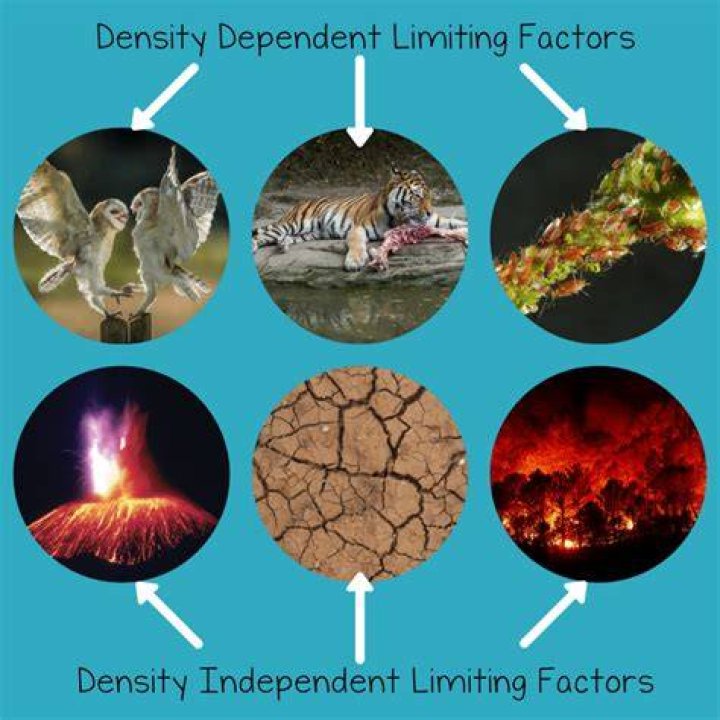
Examples of Density-Dependent Limiting FactorsThe degree of control imposed by a density-dependent factor correlates to population size such that the effect of the limitation will be more pronounced as population increases. Density-dependent factors include competition, predation, parasitism and disease.What is a density dependent population?
Density-dependent limiting factors cause a population's per capita growth rate to change—typically, to drop—with increasing population density. One example is competition for limited food among members of a population. Density-independent factors affect per capita growth rate independent of population density.What are some examples of density independent limiting factors?
Small populations are particularly at risk of being wiped out by density independent limiting factors. The category of density independent limiting factors includes fires, natural disasters (earthquakes, floods, tornados), and the effects of pollution.What is a density dependent limiting factor?
The density dependent factors are factors whose effects on the size or growth of the population vary with the population density. There are many types of density dependent limiting factors such as; availability of food, predation, disease, and migration. However the main factor is the availability of food.What are density dependent effects?
Density-independent factors, such as weather and climate, exert their influences on population size regardless of the population's density. In contrast, the effects of density-dependent factors intensify as the population increases in size. For example, some diseases spread faster in populations where…Is human activity density dependent?
Density independent factors can affect a population no matter what it's density is. For example: natural disasters, temperature, sunlight, human activities, physical characteristics and behaviours of organisms affect any and all populations regardless of their densities.Is disease a density dependent factor?
Density-dependent factors include disease, competition, and predation. Density-dependant factors can have either a positive or a negative correlation to population size.How do density dependent and density independent factors affect population growth?
Density-dependent regulation can be affected by factors that affect birth and death rates such as competition and predation. Density-independent regulation can be affected by factors that affect birth and death rates such as abiotic factors and environmental factors, i.e. severe weather and conditions such as fire.Is drought a density dependent factor?
Density-dependent limiting factors: Competition, predators, herbivores, parasitism, and overcrowding. Why is drought a density-independent limiting factor? Because if there is a drought, it doesn't deal with the population of the environment.Is water density dependent or independent?
Density-Dependent Factors DefinedThese resources, such as food, water, and shelter, are essential to life. Each population has a size that is 'just right' for it, and there are natural methods to control population growth. One very important mechanism for regulating population size is density dependence.What factors regulate the size of a population?
Factors that regulate population size includes density-dependent factors such as limit on food or water supply, and density-independent factors, such as natural disasters or climate change.What is density dependent inhibition in cell division?
What is Density-Dependent Inhibition? If a cell is crowded it will not divide. Cells will stop dividing when they are in contact with others cells.What is a Type 1 survivorship curve?
Type I or convex curves are characterized by high age-specific survival probability in early and middle life, followed by a rapid decline in survival in later life. They are typical of species that produce few offspring but care for them well, including humans and many other large mammals.Why is density dependence important?
Density Dependence. Density dependence is important to conservation because it can lead to either population regulation (i.e., stabilization of population size) or population destabilization (thus increasing the probability of population crashes and extinction).What are density dependent factors Answers com?
The density dependent factor refers to the factors that affect the size or growth of a given population density. The factors also affect the mortality rate and the birth rate of a population. Some of the density dependent factors are disease, parasitism, availability of food and migration.Is interspecific competition density dependent?
By contrast, interspecific competition occurs when members of different species compete for a shared resource. As a result, the growth rate of a population slows as intraspecific competition becomes more intense, making it a negatively density dependent process.What are the five factors that affect population?
Factors influencing population growth- Economic development.
- Education.
- Quality of children.
- Welfare payments/State pensions.
- Social and cultural factors.
- Availability of family planning.
- Female labour market participation.
- Death rates – Level of medical provision.