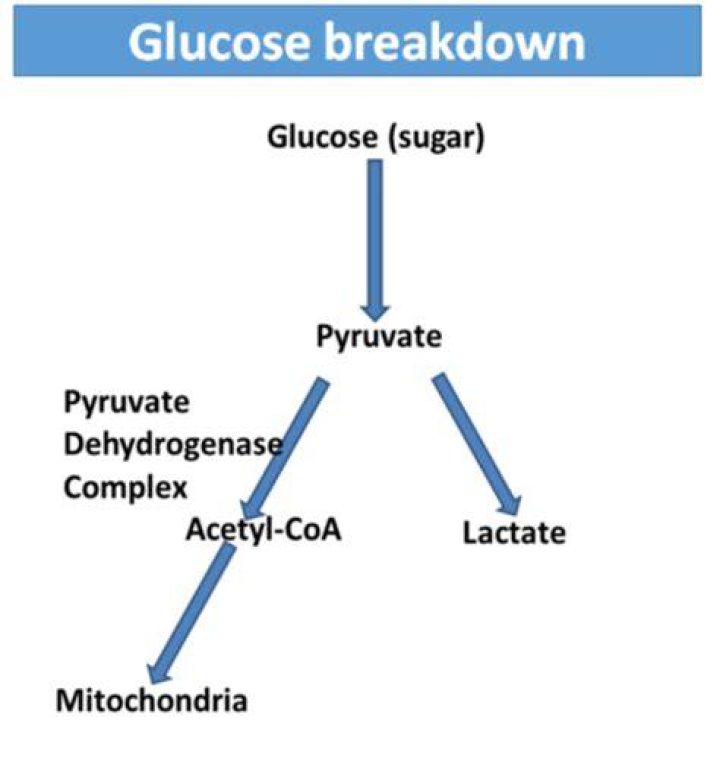
Is the anaerobic breakdown of glucose to pyruvate?
 Matthew Elliott
.
Simply so, what happens to pyruvate in anaerobic respiration?
Anaerobic conditions in yeast convert pyruvate to carbon dioxide and ethanol. This occurs with the help of the enzyme pyruvate decarboxylase which removes a carbon dioxide molecule from the pyruvate to yield an acetaldehyde.
Subsequently, question is, what is the anaerobic product of glycolysis? Anaerobic glycolysis is the transformation of glucose to lactate when limited amounts of oxygen (O2) are available. Anaerobic glycolysis is only an effective means of energy production during short, intense exercise, providing energy for a period ranging from 10 seconds to 2 minutes.
Consequently, what stores are broken down in anaerobic glycolysis?
Anaerobic glycolysis Glucose and glycogen are partially broken down by the lactate system to produce ATP. ATP is used in this breakdown, but more ATP is produced than used, each molecule of glucose produces two net (additional) molecules of ATP.
How does glucose change to pyruvate?
In a series of steps that produce one NADH and two ATP, a glyceraldehyde-3-phosphate molecule is converted into a pyruvate molecule. This happens twice for each molecule of glucose since glucose is split into two three-carbon molecules, both of which will go through the final steps of the pathway.
Related Question Answers
What happens to lactate in anaerobic respiration?
The lactate produced as a result of anaerobic respiration must be removed as it is acidic. The lactate is transported to metabolically active cells, such as the heart and brain. Here it is converted back to pyruvate by the above reaction. The pyruvate is then utilised in the Krebs cycle.What is the equation for anaerobic respiration?
The chemical equation is C6H12O6 + 6O2 → 6CO2 + 6H2O (glucose + oxygen -> carbon dioxide + water). Anaerobic respiration also produces energy and uses glucose, but it produces less energy and does not require oxygen.What is the difference between anaerobic respiration and fermentation?
Even though fermentation happens without oxygen, it isn't the same as anaerobic respiration. However, instead of ending with glycolysis, as fermentation does, anaerobic respiration creates pyruvate and then continues on the same path as aerobic respiration.Where does anaerobic respiration occur?
Anaerobic respiration (both glycolysis and fermentation) takes place in the fluid portion of the cytoplasm whereas the bulk of the energy yield of aerobic respiration takes place in the mitochondria.What is the difference between anaerobic and aerobic glycolysis?
Difference Between Aerobic and Anaerobic Glycolysis. Glycolysis via aerobic glycolysis occurs when oxygen and hydrogen atoms bond together to break down glucose, and facilitate an exchange of energy. Anaerobic glycolysis, on the other hand, occurs when glucose is broken down without the presence of oxygen.How is lactic acid produced in anaerobic respiration?
Anaerobic respiration in musclesThere is a build-up of lactic acid in the muscles during vigorous exercise. The lactic acid needs to be oxidised to carbon dioxide and water later. This causes an oxygen debt - known as excess post-exercise oxygen consumption (EPOC) - that needs to be 'repaid' after the exercise stops.What are the products of anaerobic respiration?
Answer and Explanation: The products of anaerobic respiration are lactic acid, carbon dioxide, and water. Anaerobic respiration is the breakdown of glucose in the absence ofWhy does anaerobic glycolysis occur?
Anaerobic glycolysis serves as a means of energy production in cells that cannot produce adequate energy through oxidative phosphorylation. In poorly oxygenated tissue, glycolysis produces 2 ATP by shunting pyruvate away from mitochondria and through the lactate dehydrogenase reaction.What are the end products of anaerobic glycolysis?
The net end products of glycolysis are: 2 pyruvate, 2 ATP and 2 NADH. Lactic acid is the end product of anaerobic respiration. Pyruvate is converted to lactic acid; carbon dioxide and water are also formed in anaerobic respiration. Pyruvate is converted to acetyl CoA prior to entering the TCA cycle.What are the two types of glycolysis?
There are two types of glycolysis. Aerobic Glycolysis: It occurs when oxygen is plentiful. Anaerobic Glycolysis: It occurs when oxygen is scarce. Final product is lactate along with the production of two ATP molecules.Where is ATP stored?
The energy for the synthesis of ATP comes from the breakdown of foods and phosphocreatine (PC). Phosphocreatine is also known as creatine phosphate and like existing ATP; it is stored inside muscle cells. Because it is stored in muscle cells phosphocreatine is readily available to produce ATP quickly.What enzyme breaks down lactic acid?
As lactic acid accumulates inside your muscle cells, it enters your bloodstream. Your liver soaks up the circulating lactate. Later on, while you are resting, your liver is busy oxidizing the lactic acid to pyruvate through a reaction catalyzed by an enzyme called lactate dehydrogenase.What activities use anaerobic glycolysis?
The anaerobic glycolysis system is the dominant energy system in the following sports:- Athletics: 200 m dash. 400 m dash.
- Badminton.
- Canoe/Kayak: Slalom events (all events). Sprint, women`s events (all events).
- Cycling, BMX events.
- Football (soccer).
- Gymnastics: acrobatic events (all events).
- Handball.
- Hockey (ice).
What are the products of glycolysis?
Glycolysis involves the breaking down of a sugar (generally glucose, although fructose and other sugars may be used) into more manageable compounds in order to produce energy. The net end products of glycolysis are two Pyruvate, two NADH, and two ATP (A special note on the "two" ATP later).How many ATP are produced in anaerobic respiration?
2 ATP
What happens to lactate after glycolysis?
The Cori cycle (also known as the lactic acid cycle), named after its discoverers, Carl Ferdinand Cori and Gerty Cori, refers to the metabolic pathway in which lactate produced by anaerobic glycolysis in the muscles moves to the liver and is converted to glucose, which then returns to the muscles and is cyclicallyWhat is the difference between fast and slow glycolysis?
A Quick Breakdown of Fast and Slow Glycolysis. Fast glycolysis is also known as anaerobic glycolysis and slow glycolysis is commonly called aerobic glycolysis. These are dictated by the energy demands of the cells. If there is a rapid or high rate of type II muscle fibers being utilized then fast glycolysis is utilizedHow many ATP are produced in glycolysis?
2 ATP
How many moles of ATP are produced in glycolysis?
2 moles