Is high contrast for color blind people?
 Rachel Hernandez
.
Similarly one may ask, what is the best color for a colorblind person?
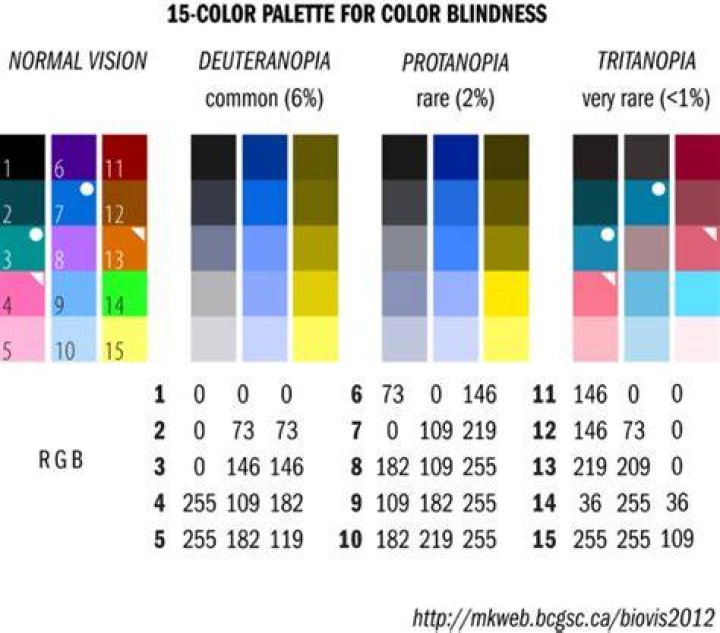
Use a colorblind-friendly palette when appropriate For example, blue/orange is a common colorblind-friendly palette. Blue/red or blue/brown would also work. For the most common conditions of CVD, all of these work well, since blue would generally look blue to someone with CVD.
Also, what colors can color blind people see? A person with color-blindness has trouble seeing red, green, blue, or mixtures of these colors. The most common type is red-green color-blindness, where red and green are seen as the same color.
Also to know, what colors should colorblind people avoid?
That being said, here's a few color combinations to avoid because they're a potential nightmare to color blind users:
- Green & Red.
- Green & Brown.
- Blue & Purple.
- Green & Blue.
- Light Green & Yellow.
- Blue & Grey.
- Green & Grey.
- Green & Black.
How can you help a colorblind person?
There is no known cure for color blindness. Contact lenses and glasses are available with filters to help color deficiencies, if needed. Fortunately, the vision of most color-blind people is normal in all other respects and certain adaptation methods are all that is required.
Related Question Answers
What color is GREY to a colorblind person?
What I am looking for are the colors we colorblind people have problems to see or distinguish.
| color confusion | protan | tritan |
|---|---|---|
| green/grey/blue-purple | ||
| red/black | X | |
| green/black | ||
| violet/yellow-green | X |
Can a colorblind person see orange?
People with deuteranomaly and protanomaly are collectively known as red-green colour blind and they generally have difficulty distinguishing between reds, greens, browns and oranges. Often their colour perception can be as poor as it is for those with dichromacy.What colors are OK for color blind?
According to Color Blind Awareness, color blindness affects 1 in 12 men (8%) and 1 in 200 women (0.5%).
Color combinations to avoid for people with color blindness include:
- Red & green.
- Green & brown.
- Green & blue.
- Blue & gray.
- Blue & purple.
- Green & gray.
- Green & black.
What are the 4 colors that people with color blindness have trouble distinguishing?
Red-green color blindness is a generic term for protanopia (red-blindness), protanomaly (red-weakness), deuteranopia (green-blindness), and deuteranomaly (green-weakness). More than 99% of all color blind people are suffering from a red-green color vision deficiency.Does a blind person see black?
The answer, of course, is nothing. Just as blind people do not sense the color black, we do not sense anything at all in place of our lack of sensations for magnetic fields or ultraviolet light. We don't know what we're missing.Can you drive if you're color blind?
People who are color blind see normally in other ways and can do normal things, such as drive. They just learn to respond to the way traffic signals light up, knowing that the red light is generally on top and green is on the bottom.Can color blindness get worse with age?
The most common kinds of color blindness are genetic, meaning they're passed down from parents. Color blindness can also happen because of damage to your eye or your brain. And color vision may get worse as you get older — often because of cataracts (cloudy areas in the lens of the eye).How do I know if Im Colour blind?
Someone with this type of colour vision deficiency may:- find it hard to tell the difference between reds, oranges, yellows, browns and greens.
- see these colours as much duller than they would appear to someone with normal vision.
- have trouble distinguishing between shades of purple.
- confuse reds with black.
What are the 3 types of color blindness?
All the Different Kinds of Color Blindness- Red-Green Color Blindness. Normal color vision is known as trichromacy–tri because it uses all three types of cones correctly allowing us to see so many brilliant colors.
- Blue-Yellow Color Blindness.
- Total Color Blindness.