How do you care for Queen Anne's lace?
 Noah Mitchell
 .
Keeping this in consideration, what do you do with Queen Anne's lace?
Queen Anne's Lace Management
- Hand-pull plants before they flower. Try not to leave small pieces of root in the soil.
- Till or dig the soil regularly to prevent young sprouts from taking roots. Don't attempt to burn Queen Anne's lace.
- Use herbicides only when other means of control are ineffective.
Subsequently, question is, how do you kill Queen Anne's lace? Chemical Control Several general-use herbicides will effectively control Queen Anne's lace without harming your grass. Herbicides that contain triclopyr and 2,4-D can help manage Queen Anne's lace in a lawn. Triclopyr and 2,4-D are systemic, selective herbicides that interfere with cell growth and division.
Thereof, how long does Queen Anne's Lace last?
three to seven days
Can you buy Queen Anne's lace?
Since it is a native plant in many areas, growing Queen Anne's lace is easy. While there are cultivated plants available for purchase, you can also gather a handful of seeds from wild plants in the fall. There is also a similar look-alike plant called bishop's flower (Ammi majus), which is far less intrusive.
Related Question Answers
Is Queen Anne's lace invasive?
You may be surprised to find the dainty Queen Anne's lace (Daucus carota),is considered a noxious weed in at least 35 states and invasive in many. Brought here from Europe you'll find it growing along roadsides, in disturbed sites, and abandoned fields. Its aggressive nature makes it a threat to some native plants.What flower looks like Queen Anne Lace?
hemlock
Is Queen Anne's lace a native plant?
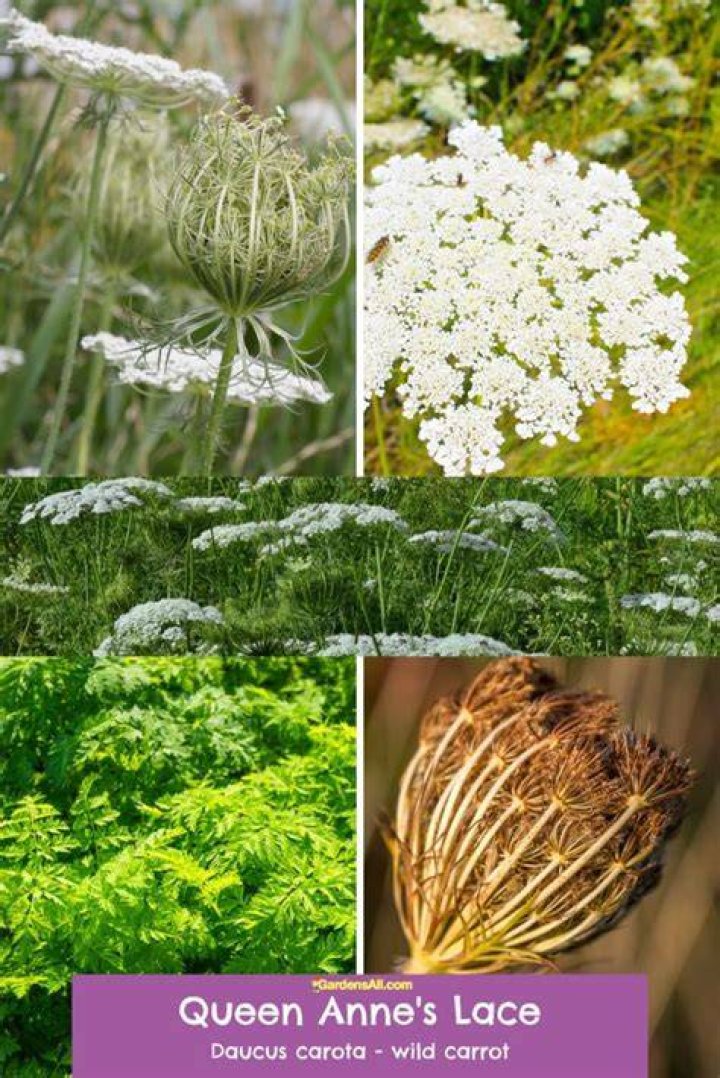
Daucus carota, whose common names include wild carrot, bird's nest, bishop's lace, and Queen Anne's lace (North America), is a white, flowering plant in the family Apiaceae, native to temperate regions of Europe and southwest Asia, and naturalized to North America and Australia.How can you tell the difference between Queen Anne's lace and hogweed?
A Queen Anne's Lace flowercap typically has a small knot of dark red or purple flowers in the center. The stem is slightly hairy and solid green. In contrast, giant hogweed has a smooth stem with reddish spots and streaks and no dark flowers in the flowercap.Why is Queen Anne's lace called wild carrot?
Queen Anne's lace earned its common name from a legend that tells of Queen Anne of England (1665-1714) pricking her finger and a drop of blood landed on white lace she was sewing. Belonging to the carrot family, Queen Anne's lace is a biennial that is also known as wild carrot.Is Queen Anne's lace a wild carrot?
Queen Anne's Lace:Also known as the wild carrot, Queen Anne's lace is in full bloom across much of "temperate" North America, Europe and Asia right now. These are indeed wild carrots, the ancestor of all cultivated carrots. By the time the flower appears, though, the root is too woody to eat.Is Queen Anne's lace deer resistant?
True. Deer and rabbits don't bother this plant. True. False Queen Anne's Lace should be kept away from grazing animals.What color is Queen Anne's lace?
Queen Anne's Lace is a pale, pure, amethyst purple with a paisley purple undertone. It is a perfect paint color for all the walls and ceiling of a room. Pair it with any color of your choice.Is Queen Anne's lace a wildflower?
Queen Anne's Lace (Daucus Carota) is a nonnative wildflower with feathery leaves and clusters of tiny white flowers that bloom in summer.Is Queen Anne's lace dangerous?
First, Queen Anne's Lace is NOT poisonous: it is perfectly edible. In fact, “Queen Anne's Lace” is actually just a common name for Daucus Carota, which also goes by the name “wild carrot.” Generally speaking, once you can see the flower, the carrot is too mature to eat because of texture, not because of any danger.Does Queen Anne's lace spread?
Queen Anne's Lace Pests and ProblemsIn many areas here in the U.S., Queen Anne's Lace is considered a noxious weed or an invasive species. It spreads very quickly and prefers the warm, humid conditions of its native lands. So, if you live in a warm and muggy region, be extra careful.What does Queen Anne's lace symbolize?
The symbolic meaning for Queen Anne's Lace is that it represents sanctuary. It grows quite easily as a wildflower as its seeds spread easily and quickly in the wind, leaving many new flowers next to roads and throughout fields across the United States.Is Queen Anne lace annual or perennial?
Queen Anne's lace may also refer to plants with flowers similar to Daucus carota, including: Ammi majus, originates in the Nile River Valley. Anthriscus sylvestris, a herbaceous biennial or short-lived perennial plant in the family Apiaceae.Is Queen Anne's lace poisonous to cattle?
It is potentially poisonous if ingested by livestock or humans in both its vegetative growth stages and when dry. Poison hemlock is often confused with Queen Anne's lace, a non-toxic weed. Both plants produce leaves and clusters of small, white flowers that look somewhat similar.Is wild carrot toxic to horses?
Mild neurotoxicity to horses was reported in Europe but is not considered a serious threat in North America. Wild carrot, also known as Queen Anne's lace, is an erect biennial that can grow to about 4 feet in height. However, to avoid any potential problems, remove wild carrot plants from pastures.What herbicide kills wild carrot?
For herbicide selection, while wild carrot rosettes are more tolerant to glyphosate, increasing rates to 1.34 l/ac. of glyphosate 540 g/l (e.g. Roundup Transorb) has generally worked, with fall applications being more effective than spring.How do you grow chocolate lace flowers?
Chocolate Lace Flower Dara- Chocolate Lace Flower 'Dara' Daucus carota.
- Details: Plant type: annual. Height: 36-48”
- How to Grow: Start seed indoors in trays 6-8 weeks before last frost; transplant out after all danger of frost has passed.
- Harvesting/Vase Life: Pick when flowers have fully opened and are laying flat.