What is server virtualization in cloud computing?
 William Jenkins
 .
Keeping this in consideration, what is a virtualization server?
Server virtualization is a virtualizationtechnique that involves partitioning a physical server intoa number of small, virtual servers with the help ofvirtualization software. In server virtualization,each virtual server runs multiple operating system instancesat the same time.
Also, does cloud use server virtualization? However, virtualization is not cloudcomputing. In enterprise networks, virtualization andcloud computing are often used together to build aprivate cloud infrastructure. Virtualization softwareallows one physical server to run several individualcomputing environments.
Moreover, what is server virtualization How it works?
Server virtualization is the masking ofserver resources, including the number and identity ofindividual physical servers, processors, and operating systems,from server users. The server administrator uses asoftware application to divide one physical server intomultiple isolated virtual environments.
What are the 3 types of virtualization?
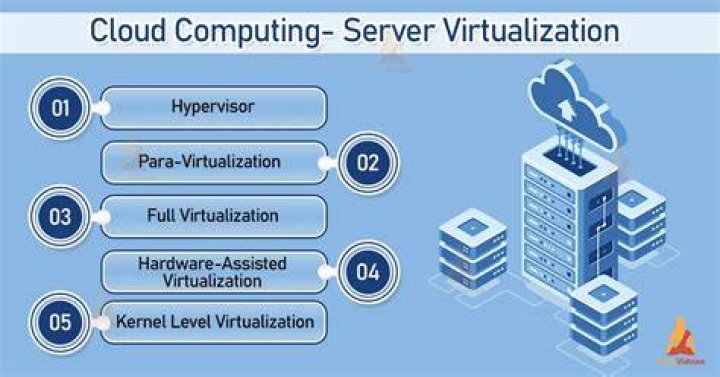
Three Kinds of Server Virtualization.There are three ways to create virtual servers: fullvirtualization, para-virtualization and OS-levelvirtualization. They all share a few common traits. Thephysical server is called the host.
Related Question Answers
What is the benefit of virtualization?
Virtualization can increase IT agility,flexibility and scalability while creating significant costsavings. Greater workload mobility, increased performance andavailability of resources, automated operations – they're allbenefits of virtualization that make IT simpler to manageand less costly to own and operate.What is virtualization used for?
Virtualization is technology that lets you createuseful IT services using resources that are traditionally bound tohardware. It allows you to use a physical machine's fullcapacity by distributing its capabilities among many users orenvironments.Is a VM a server?
A virtual machine (VM) is a softwarecomputer used as emulation of an actual physical computer. Avirtual server operates in a “multi-tenant”environment, meaning that multiple VMs run on the same physicalhardware. A hypervisor is then used to create and manage VMs, whichhave their own virtual computing resources.What is virtualization and types?
What Types of Virtualization Are There?Virtualization can be utilized in many different ways andcan take many forms aside from just server virtualization.The main types include application, desktop, user, storageand hardware.What are the benefits of server virtualization?
Advantages of Server Virtualization. Savesmoney on IT costs. When you partition one physical server intoseveral virtual machines, you can deploy, operate and managemultiple operating system instances at once on that single physicalserver. Fewer physical servers mean less money spent onthose servers.What is virtualization with example?
In computing, virtualization means to create avirtual version of a device or resource, such as a server, storagedevice, network or even an operating system where the frameworkdivides the resource into one or more executionenvironments.What are the disadvantages of virtualization?
The Disadvantages of Virtualization- It can have a high cost of implementation.
- It still has limitations.
- It creates a security risk.
- It creates an availability issue.
- It creates a scalability issue.
- It requires several links in a chain that must work togethercohesively.
- It takes time.
How does server virtualization work?
By using specially designed software, an administratorcan convert one physical server into multiple virtualmachines. Each virtual server acts like a unique physicaldevice, capable of running its own operating system (OS). But it'sonly been a few years since virtualization has becomefeasible for servers.What problems does virtualization solve?
Let's look at the top five top problems with virtualizationand consider tactics to address them.- Virtual machine sprawl wastes valuable computingresources.
- VMs can congest network traffic.
- Consolidation will multiply the impact of server hardwarefailures.
- Application performance can still be marginal in a VM.