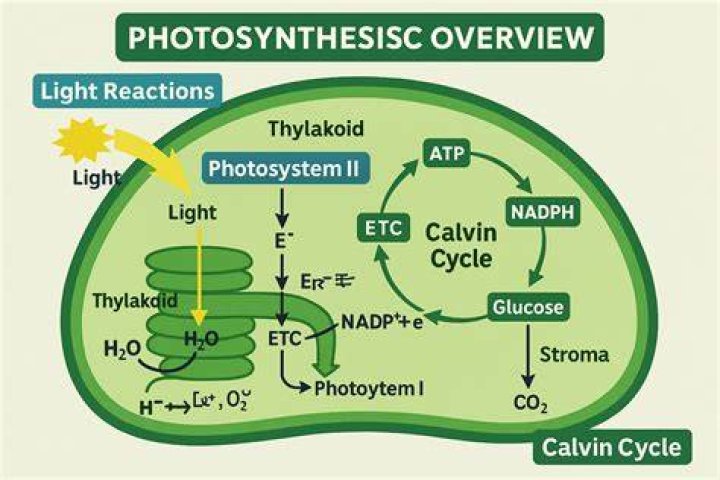
Where is the exact site of the light stage of photosynthesis?
 James Craig
 thylakoid membrane
.
Similarly, you may ask, which part of the chloroplast is the site of light reaction?
thylakoid discs
Furthermore, what are the two main stages of photosynthesis and where do they occur? The two stages of photosynthesis: Photosynthesis takes place in two stages: light-dependent reactions and the Calvin cycle (light-independent reactions). Light-dependent reactions, which take place in the thylakoid membrane, use light energy to make ATP and NADPH.
Beside above, what is the actual site of photosynthesis?
Chloroplast
How does the water get to the site of photosynthesis?
Water. The water needed for photosynthesis is absorbed through the roots and transported through tubes to the leaf. The roots have a type of cell called a root hair cell. Note that root cells do not contain chloroplasts, as they are normally in the dark and cannot carry out photosynthesis.
Related Question Answers
What is a stack of thylakoids called?
A granum (plural grana) is a stack of thylakoid discs. Chloroplasts can have from 10 to 100 grana. Grana are connected by stroma thylakoids, also called intergranal thylakoids or lamellae.How many ATP are formed in light reaction?
2 ATP
What are the products of the light dependent reactions?
The products of the light-dependent reactions, ATP and NADPH, are both required for the endergonic (def) light-independent reactions. The light-dependent reactions involve two photosystems called Photosystem I and Photosystem II.What are the products of dark reactions?
The dark reaction occurs outside of the thylakoids. In this reaction, the energy from ATP and NADPH are used to fix carbon dioxide (CO2). The products of this reaction are sugar molecules and other organic molecules necessary for cell function and metabolism.What is the dark reaction in photosynthesis?
Dark reactions make use of these organic energy molecules (ATP and NADPH). This reaction cycle is also called Calvin Benison Cycle, and it occurs in the stroma. ATP provides the energy while NADPH provides the electrons required to fix the CO2 (carbon dioxide) into carbohydrates.What is the process of light dependent reaction?
The overall function of light-dependent reactions, the first stage of photosynthesis, is to convert solar energy into chemical energy in the form of NADPH and ATP, which are used in light-independent reactions and fuel the assembly of sugar molecules.Which is the site of the light dependent reactions of photosynthesis?
thylakoid membranes
What is the function of photosystem 1?
Photosystem I (PSI, or plastocyanin-ferredoxin oxidoreductase) is the second photosystem in the photosynthetic light reactions of algae, plants, and some bacteria. Photosystem I is an integral membrane protein complex that uses light energy to produce the high energy carriers ATP and NADPH.Why do we called leaves are site of photosynthesis?
Leaf is considered to be the best site of Photosynthesis because in a plant the leaves have the maximum surface area and it can perform photosynthesis in a more efficient way as the rate of photosynthesis increases with the increase in the surface area available for photosynthesis.What is photosynthesis explain with diagram?
Through a process called photosynthesis, plants use energy in sunlight to turn a gas called carbon dioxide and water into sugar. Plants then use this sugar to grow. At the same time, plants produce a gas called oxygen as a waste product, which is lucky for us and other animals because we need oxygen to breathe!Why leaves are the major site of photosynthesis?
The primary function of leaves is to absorb the sunlight that drives photosynthesis. Beyond this, through their tiny stomata, leaves serve as the plant's primary entry and exit points for gases. The most important gas that's entering is carbon dioxide, which is one of the starting ingredients for photosynthesis.Which organelle is the site of photosynthesis?
Chloroplasts
What is the basic process of photosynthesis?
Photosynthesis, the process by which green plants and certain other organisms transform light energy into chemical energy. During photosynthesis in green plants, light energy is captured and used to convert water, carbon dioxide, and minerals into oxygen and energy-rich organic compounds.In which part of plant photosynthesis occurs?
chloroplasts