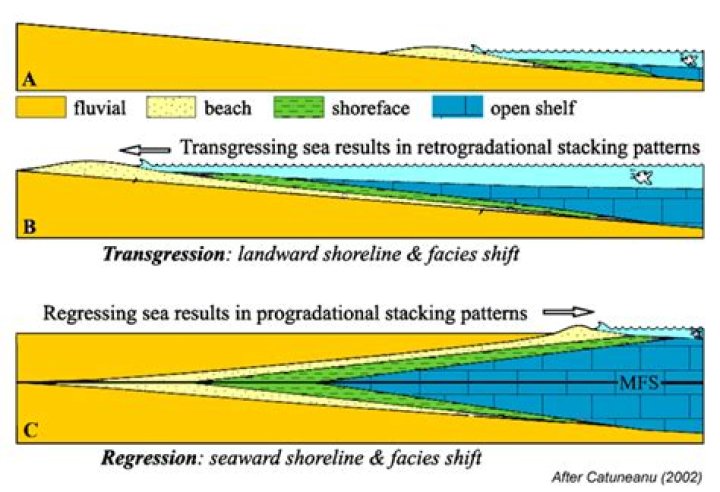
What is the difference between transgression and regression?
 James Craig
 .
Also know, how are a marine transgression and regression different?
Marine regression. Marine regression is a geological process occurring when areas of submerged seafloor are exposed above the sea level. The opposite event, marine transgression, occurs when flooding from the sea covers previously exposed land.
One may also ask, what kind of rocks will be deposited during a regression? In this case, continental sediments are being deposited farther out to sea than they once were. Therefore, we see a sequence (from bottom to top) of: limestone ? shale ? sandstone. A maximum regression occurs where the coarsest sediments reach the farthest seaward.
Subsequently, question is, what is a transgressive sequence?
A marine transgression is a geologic event during which sea level rises relative to the land and the shoreline moves toward higher ground, resulting in flooding. Transgressions can be caused either by the land sinking or the ocean basins filling with water (or decreasing in capacity).
What are the four different sizes of clastic sediment?
Clastic sedimentary rocks are named according to the grain size of the sediment particles.
- Conglomerate = coarse (64 mm to >256 mm), rounded grains.
- Breccia = coarse (2mm to 64 mm), angular grains.
- Sandstone = grains ranging in size from 2mm to 1/16 mm.
- Shale = grains ranging in size from 1/16 mm to.
Related Question Answers
How do you identify a depositional environment?
To identify depositional environments, geologists, like crime scene investigators, look for clues. Detectives may seek ?ngerprints and bloodstains to identify a culprit. Geologists examine grain size, composition, sorting, bed-surface marks, cross bedding, and fossils to identify a depositional environment.What does progradation mean?
In sedimentary geology and geomorphology, the term progradation refers to the growth of a river delta farther out into the sea over time. Progradation can be caused by: Periods of sea-level fall which result in marine regression.What is Walther's Law?
Walther's Law states that any vertical progression of facies is the result of a succession of depositional environments that are laterally juxtaposed to each other.Where are sedimentary rocks deposited?
Sedimentary rocks are types of rock that are formed by the accumulation or deposition of small particles and subsequent cementation of mineral or organic particles on the floor of oceans or other bodies of water at the Earth's surface.What is marine unconformity?
marine unconformities are that such are connected with changes of. sea-level—an invasion of the land by the sea following a negative. movement of the land, or a relative rise of sea-level due to other. causes; that an unconformity beneath marine deposits is accompanied.What is Retrogradation geology?
Retrogradation is the landward change in position of the front of a river delta with time. This occurs when the mass balance of sediment into the delta is such that the volume of incoming sediment is less than the volume of the delta that is lost through subsidence, sea-level rise, and/or erosion.What are the different sedimentary environments?
Types of depositional environmentsFluvial - processes due to moving water, mainly streams. Common sediments are gravel, sand, and silt. Lacustrine - processes due to moving water, mainly lakes. Common sediments are sand, silt, and clay.How do Unconformities form?
Unconformities are gaps in the geologic rock record. They are surfaces of contact between older rocks and younger sedimentary rocks, formed due to erosion or lack of sediment deposition over extended periods of time.What could cause the Paleozoic sea level to fall in a marine regression?
What could cause sea level to fall in a marine regression? Geologists think that the Paleozoic marine transgressions and regressions were the result of the decrease and increase in the size of glaciers covering the lands.What rock sequence indicates a marine transgression?
Look at the sequence in the Figure below and see if you can determine whether the sea was transgressing or regressing. At the bottom, the Tonto Group represents a marine transgression: sandstone (11), shale (10), and limestone (9) laid down during 30 million years of the Cambrian Period.Who developed the statistical technique known as regression?
Francis Galton
What is the first cratonic sequence recorded in North America?
The Sauk sequence was the earliest of the six cratonic sequences that have occurred during the Phanerozoic in North America. It was followed by the Tippecanoe, Kaskaskia, Absaroka, Zuñi, and Tejas sequences.What type of rock is shale?
sedimentary rock