What is a flow divider?
 Matthew Elliott
.
Herein, how does a flow divider work?
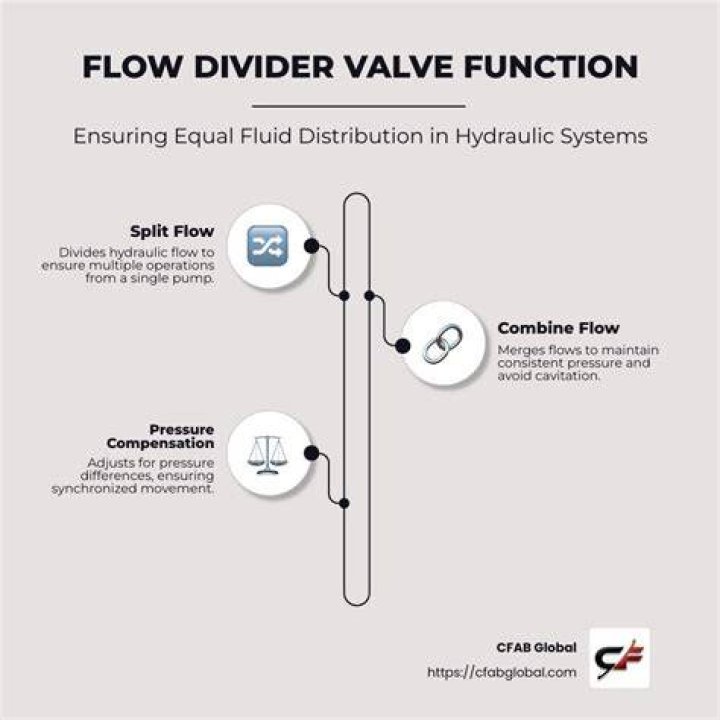
A flow divider accepts a flow of oil under pressure, usually from a hydraulic pump, and divides it into two streams of equal (or unequal) flow volume for operation of two independent branch circuits from one pump, or for synchronization of two identical cylinders.
Additionally, how does a priority flow control valve work? Priority style pressure compensator flow control valves maintain constant priority flow to one leg of a circuit regardless of any changes in load or inlet pressure. As flow enters the inlet port of the cartridge, it passes through the control orifice. A pressure differential is created across the compensator spool.
Subsequently, question is, what is hydraulic flow?
Hydraulic flow, or flow rate, is defined as the volume of a substance that flows through a defined surface area over a specified period of time. The units of a flow rate are volume per time, and it is mathematically represented by a capital letter Q. The value you just calculated is the hydraulic flow.
What is pressure compensation?
The valve compensates for changes in downstream pressure by opening and closing to increase or decrease its orifice. Essentially, pressure compensation is when a hydraulic component can ready load or system pressure and adjust itself to make up for changes in those pressures.
Related Question Answers
How does a pressure compensated flow control valve work?
The pressure compensator maintains a constant internal pressure drop across the variable orifice by automatically adjusting volume flow rate delivered to the variable orifice from the flow supply in response to changing pressure drop between the inlet and outlet of the valve.How can flow rate be regulated?
For every pressure, the pump will only deliver one specific flow rate. Therefore, to control the flow of a centrifugal pump, simply set the output pressure to the point on the P-V diagram that allows the pump to deliver the desired flow rate. The output pressure of the pump is set using a back pressure regulator.What is relation between flow and pressure?
Bernoulli's equation states mathematically that if a fluid is flowing through a tube and the tube diameter decreases, then the velocity of the fluid increases, the pressure decreases, and the mass flow (and therefore volumetric flow) remains constant so long as the air density is constant.What is called hydraulic?
Hydraulic power, also called Fluid Power, power transmitted by the controlled circulation of pressurized fluid, usually a water-soluble oil or water–glycol mixture, to a motor that converts it into a mechanical output capable of doing work on a load.What is flow area?
The flow rate depends on the area of the pipe or channel that the liquid is moving through, and the velocity of the liquid. If the liquid is flowing through a pipe, the area is A = πr2, where r is the radius of the pipe. For a rectangle, the area is A = wh where w is the width, and h is the height.What does P and T mean in hydraulics?
Standard port labeling convention on hydraulic valves is P stands for pump (high pressure input) and T stands for tank (low pressure return to reservior).What is full flow pressure?
(Also called a "pressure drop.") Full-Flow Pressure - The pressure at which a valve is wide open and passes its full flow. Operating Pressure - The pressure at which a system is normally operated. Pilot Pressure - Auxiliary pressure used to actuate or control a component.How do you adjust a flow control valve?
Open a flow control valve by turning it in the counterclockwise direction. Use the recommended number of turns or fractional turn to open the valve for the desired pressure. Set the valve to the desired pressure by turning it to a specific setting, or by measuring with a pressure meter downstream.How do you increase hydraulic flow?
Why should you use an intensifier- Low operating pressure in the system.
- Use existing installed power source.
- Use standard tubing, hoses and valves.
- Easy to accommodate where needed.
- No need for extra tubing or special parts.
- Full flow available at pump pressure.
- Use existing equipment for the new task.
What creates hydraulic flow?
A hydraulic pump is a mechanical device that converts mechanical power into hydraulic energy. It generates flow with enough power to overcome pressure induced by the load. Second, its mechanical action delivers this liquid to the pump outlet and forces it into the hydraulic system.Which valve is best for flow control?
Continue reading to learn more about each of these types of flow control valves and their functions.- Gate Valves. Gate valves are general service valves primarily used for on/off, non-throttling service.
- Globe Valves.
- Pinch Valves.
- Diaphragm Valves.
- Needle Valves.
What is the use of flow control valve?
Control System: 9 Uses for Flow Control Valve. Flow control valves are special fittings designed for use in complex hydraulic and pneumatic systems. It regulates the flow or pressure of the fluid. Control valves usually respond to signals generated by independent devices such as flow meters or temperature gauges.What are different types of control valves?
List of common types of control valve- Sliding Stem. Globe valve. Angle body valve. Angle seat piston valve.
- Rotary. Butterfly valve. Ball valve.
- Other. Pinch valve. Diaphragm valve.
Can butterfly valve be used for flow control?
Unlike gate valves, butterfly valves can be used for throttling or regulating flow as well as in the full open and fully closed position. The pressure loss through a butterfly valve is small in comparison with the gate valve. The L/D ratio for this type of valve is approximately one-third of that of a gate valve.What are the three methods of applying flow control valves?
These options include:- Orifices.
- Flow regulators.
- Bypass flow regulators.
- Demand-compensated flow controls.
- Pressure-compensated, variable flow valves.
- Pressure- and temperature-compensated, variable flow valves.
- Priority valves.
- Deceleration valves.