How many miles did a covered wagon travel in one day?
 James Craig
 .
Also, how many miles did the pioneers travel per day?
7:00 am: After every family has gathered their teams and hitched them to wagons, a trumpeter signals a “Wagons Ho,” to start the wagons down the trail. Average distance covered in a day was usually fifteen miles, but on a good day twenty could be traveled.
how long did it take to travel the Oregon Trail by wagon? four to six months
In this regard, how long did it take to cross the country in a covered wagon?
The covered wagon made 8 to 20 miles per day depending upon weather, roadway conditions and the health of the travelers. It could take up to six months or longer to reach their destination.
How much would a covered wagon hold?
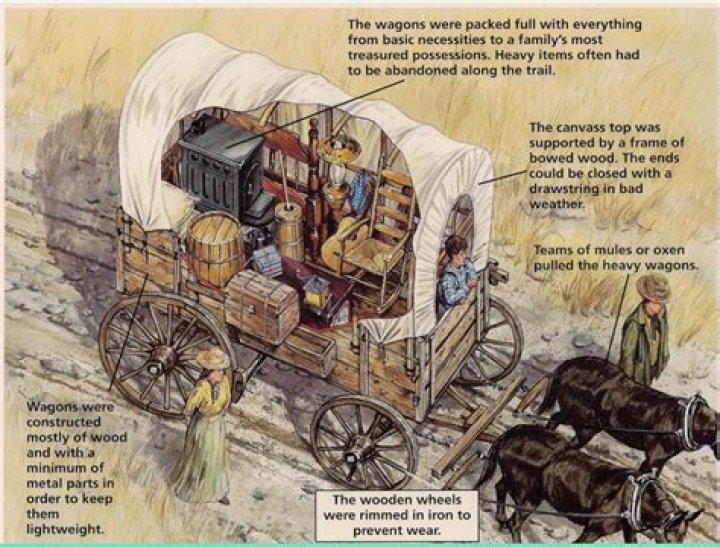
A typical prairie schooner weighed about 1,300 pounds (590 kg) when empty, and the general goal was to keep the weight of the added cargo to no more than 2,000 pounds (900 kg). Teams of 10 to 12 horses or mules or six yoked oxen typically were used to pull one of these wagons, with mules and oxen generally preferred.
Related Question Answers
What were two main causes of death along the trail?
Nearly one in ten who set off on the Oregon Trail did not survive. The two biggest causes of death were disease and accidents. The disease with the worst reputation was Asiatic cholera, known as the “unseen destroyer.”How much did a covered wagon cost in the 1800s?
How much was a wagon in the 1800s? It depended on the wagon and which decade you're talking about, as well as the geographical location and the vendor. A low-end buggy in the 1860's-1870's probably cost between $25 and $30. A large wagon would be ten times that amount, or more.Where did Pioneers sleep?
Some pioneers did sleep in their wagons. Some did camp on the ground—either in the open or sheltered under the wagon. But many used canvas tents. Despite the romantic depictions of the covered wagon in movies and on television, it would not have been very comfortable to travel in or sleep in the wagon.What did the pioneers eat on the trail?
Pioneers took most of their own food and every day the meals were pretty much the same: usually bread, beans, bacon, ham, and dried fruit over and over again. Occasionally they had fresh fish or buffalo or antelope hunted along the way. Many of families took along a milk cow so they were able to have fresh milk.Why is it called the Oregon Trail?
Everything from California to Alaska and between the Rocky Mountains and the Pacific Ocean was a British-held territory called Oregon. The trail pointed the way for the United States to expand westward to achieve what politicians of the day called its “Manifest Destiny” to reach “from sea to shining sea.”What's a wagon tongue?
1 any of various types of wheeled vehicles, ranging from carts to lorries, esp. a vehicle with four wheels drawn by a horse, tractor, etc., and used for carrying crops, heavy loads, etc.How far can a carriage travel in a day?
It takes a horse and carriage an average of 8 to 12 hours to travel 50 miles. At that rate, a horse and carriage can cover 100 to 150 miles in 24 hours, including stops to rest and eat. Horse-drawn vehicles can have either two or four wheels and can be pulled by two to four horses.How I died on the Oregon Trail?
Death was rampant on the Oregon Trail. These deaths were mostly in part to disease or accidents. Diseases ranged from a fever to dysentery, but the most deadly disease was cholera. This disease stole into the shadows and reared its ugly head from the unsanitary conditions on the trail.When did they stop using covered wagons?
The decline of wagon trains in the United States started in 1869, with the completion of the first transcontinental railroad, and wagon trains as a way of migrating essentially ended in the 1890s. Covered wagons, on the other hand, stuck around for a long time.How much did oxen cost in the 1800s?
The cost of a yoke of oxen during the last half of the 1840s varied from a low of $25 to a high of $65.What was in a covered wagon?
A covered wagon is a large wooden vehicle covered with a canvas tent stretched over the top. In early America, people would pack these wagons full of their belongings and head out onto the open road.How much did it cost to join a wagon train?
What was the cost of the westward wagon trains? The overland journey from Independence, Missouri, to Oregon or California meant a six-month trip across 2,000 miles of hard country. It was costly—as much as $1,000 for a family of four. That fee included a wagon at about $100.How big was a covered wagon that the pioneers used?
Prairie Schooners were not early campersWe may have an image in our heads about early pioneers settling to sleep each night, safely tucked into beds inside their covered wagon. But this is not accurate. The wagons were surprisingly small, measuring only about four feet wide and eight or nine feet long.What is a group of wagons called?
A wagon train is a group of wagons traveling together. In the American West, settlers traveling across the plains and mountain passes in covered wagons banded together for mutual assistance.How long did it take to travel the California Trail?
four to six months
Can you still walk the Oregon Trail?
Hiking GearBut most stretches of the trail can still be traversed by foot, including sections under the auspices of the National Park Service. Some stretches of the trail are in state parks, such as Three Islands State Park in Idaho, where pioneers crossed the Snake River.Why did settlers circle their wagons at night?
“To be on the safe side, the pioneers drew their wagons into a circle at night to create a makeshift stockade. If they feared Indians might raid their livestock—the Plains tribes valued the horses, though generally ignored the oxen—they would drive the animals into the enclosure.”How many died on the Oregon Trail?
Answer and Explanation: The conservative estimates are that around 5% of migrants died on the trail. With an estimated 300,000 pioneers, that means that approximately 15,000How do you win the Oregon Trail?
Beatthe first one and Oregon Trail II several times.
- When hunting try to kill Buffalo or Bear.
- Float the wagon or take a ferry instead of trying to ford rivers if the river is over 2 feet deep.
- Don't run out of ammunition and food.
- Just keep one spare part of each type.
- Travel at a grueling pace.
- Leave in March.