Although it is not visible, air pressure affects the weather pattern to a great extent. Rising air creates low pressure while sinking air creates high pressure. As a result, air rises and cools; clouds and precipitate are formed. Low air pressure produces unstable weather conditions like rain or storms..
Also to know is, how does pressure affect precipitation?
Rising Air Condenses High and low pressure readings are an indicator of how much weight the atmosphere is pushing down on a particular area. When the pressure is low, the air is free to rise into the atmosphere where it cools and condenses. Eventually the water vapor in the clouds condenses and falls as rain.
Beside above, how does air pressure affect us? Barometric pressure is the weight of the atmosphere that surrounds us. Barometric pressure often drops before bad weather. Lower air pressure pushes less against the body, allowing tissues to expand. Expanded tissues can put pressure on joints and cause pain.
One may also ask, how is precipitation related to high and low pressure air?
Basically, air cools as it rises, which can cause water vapor in the air to condense into liquid water droplets, sometimes forming clouds and precipitation. Well, high pressure is associated with sinking air, and low pressure is associated with rising air.
What happens when there is low air pressure?
A low pressure system has lower pressure at its center than the areas around it. Winds blow towards the low pressure, and the air rises in the atmosphere where they meet. As the air rises, the water vapor within it condenses forming clouds and often precipitation too.
Related Question Answers
Is Sunny high or low pressure?
“Sunny,” for instance, can usually be found in the range of high barometric pressure — 30.2 or 30.3 inches. “Stormy,” on the other hand would be found in the range of low barometric pressure — 29.2 or lower, perhaps even on occasion below 29 inches.How does precipitation occur?
Precipitation occurs when a portion of the atmosphere becomes saturated with water vapor, so that the water condenses and "precipitates". Precipitation forms as smaller droplets coalesce via collision with other rain drops or ice crystals within a cloud.At what pressure does it rain?
Air rises in a low pressure area and falls in a high pressure area. In a low pressure area the rising air cools and this is likely to condense water vapour and form clouds, and consequently rain. The opposite is true in a high pressure area, which is why high pressure tends to give cloudless skies.What causes low pressure weather?
Low pressure areas form when atmospheric circulations of air up and down remove a small amount of atmosphere from a region. This usually happens along the boundary between warm and cold air masses by air flows "trying" to reduce that temperature contrast.What does high air pressure cause?
The Earth's atmosphere exerts pressure on the surface. Areas of high and low pressure are caused by ascending and descending air. As air warms it ascends, leading to low pressure at the surface. As air cools it descends, leading to high pressure at the surface.What instrument measures air pressure?
barometer
How does temperature affect precipitation?
A warming atmosphere causes more evaporation, meaning more water is available for precipitation. For every 1°F increase in temperature, the atmosphere can hold around 4 percent more water vapor, which leads to heavier rain and increases the risk of flooding of rivers and streams.What is considered high pressure in weather?
Well, at sea level, the average barometric pressure should be somewhere around 1.013 * 10^5 Pa, or around 1,013 millibars, or 29.92 inches of Mercury. “High pressure” basically means “above-average pressure.” When you're above 1,013 millibars, you're generally approaching high pressure systems.What is the definition of high air pressure?
A high-pressure area, high, or anticyclone, is a region where the atmospheric pressure at the surface of the planet is greater than its surrounding environment. Many of the features of Highs may be understood in context of middle- or meso-scale and relatively enduring dynamics of a planet's atmospheric circulation.What is the relationship between humidity and precipitation?
Connection of Rain and HumidityWhen it rains, it will increase the relative humidity because of the evaporation. The air where the rain is falling may not be completely saturated with water vapor. However, the longer it rains, the more the humidity will increase because of the air constantly drawing the water.What is normal weather Pressure?
Atmospheric pressure can also be measured in millibars (mb), with a "bar" being roughly equivalent to one atmosphere of pressure (one atmosphere equals 1.01325 bars). One bar is equivalent to 29.6 in. Hg. A barometer reading of 30 inches (Hg) is considered normal.Does high pressure cause clouds?
Low-pressure systems are associated with clouds and precipitation that minimize temperature changes throughout the day, whereas high-pressure systems normally associate with dry weather and mostly clear skies with larger diurnal temperature changes due to greater radiation at night and greater sunshine during the day.What do you mean by pressure?
Pressure is defined as the physical force exerted on an object. The force applied is perpendicular to the surface of objects per unit area. Unit of pressure is Pascals (Pa).How do high pressure systems form?
A high pressure system occurs where the air mass above the Earth is denser than in surrounding areas, and therefore exerts a higher force or pressure.Is high pressure warm or cold?
Is High Pressure Always Warm Air? High pressure systems can be cold or warm, humid or dry. The origin of a high-pressure region determines its weather characteristics. If a high-pressure system moves into Wisconsin from the south during the summer, the weather is usually warm and clear.What are two types of pressure systems?
Dense air sinks, bringing clear skies and fair weather. 4 ? Low-pressure system is a large body of circulating air with low pressure at its center and higher pressure outside of the system. Air inside system rises and cools Water vapor condenses forming clouds and sometimes precipitation.What is called air pressure?
That pressure is called atmospheric pressure, or air pressure. It is the force exerted on a surface by the air above it as gravity pulls it to Earth. Atmospheric pressure is commonly measured with a barometer. One atmosphere is 1,013 millibars, or 760 millimeters (29.92 inches) of mercury.Can the barometric pressure affect the human body?
“Barometric pressure is atmospheric pressure, the weight of the atmosphere,” said headache specialist Dr. Barometric pressure changes affect our bodies in a handful of ways. Some people may be more sensitive to weather changes than others, like people with Migraine or arthritis.Why is it important to know the air pressure?
These factors are important because they determine the temperature and density of the air and thus its pressure. The number of air molecules above a surface determines air pressure. As the number of molecules increases, they exert more pressure on a surface and the total atmospheric pressure increases. 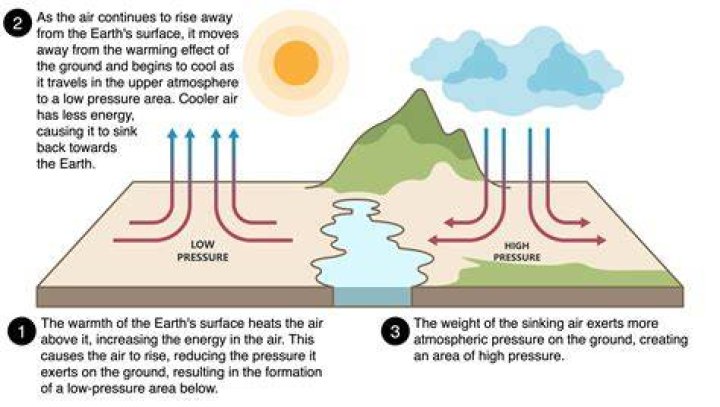
 Rachel Hernandez