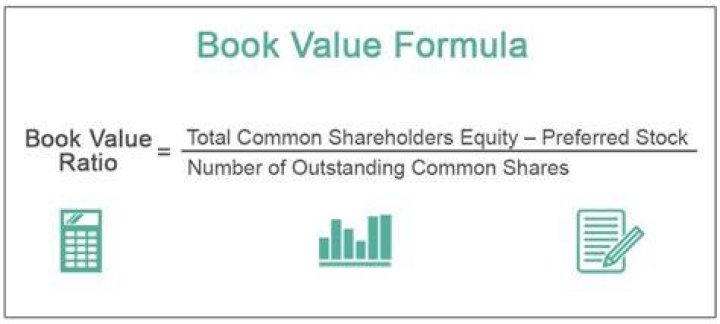
The book value per share (BVPS) is calculated by taking the ratio of equity available to common stockholders against the number of shares outstanding. When compared to the current market value per share, the book value per share can provide information on how a company's stock is valued..
Also, how do you calculate book value per share?
The book value of a stock = book value of total assets – total liabilities. The book value calculation in practice is even simpler. If you look up any balance sheet you will find that it is divided in 3 sections: Assets, Liabilities and Shareholders Equity.
is book value per share the same as price per share? Also defined as a firm's next asset value, book value per share is essentially the total assets of a company, but not counting a firm's assets and liabilities. When book value per share is high compared to a company's share price, the company's stock is deemed as undervalued.
Keeping this in view, how do you calculate price per share?
Start by adding the net proceeds to the costs in order to find the gross (total) proceeds from the stock issuance. Then, divide the gross proceeds by the number of shares issued to calculate the issue price per share.
Is high book value per share good?
If a company's BVPS is higher than its market value per share—its current stock price—then the stock is considered undervalued. However, as the assets would be sold at market prices, and book value uses the historical costs of assets, market value is considered a better floor price than book value for a company.
Related Question Answers
What is the formula for book value per share?
Book Value per Share Formula: What is the formula? Book value indicates the difference between the total assets and the total liabilities. When the book value is divided by the number of common shares, we get book value per share.What is a good book value?
The price-to-book (P/B) ratio has been favored by value investors for decades and is widely used by market analysts. Traditionally, any value under 1.0 is considered a good P/B value, indicating a potentially undervalued stock. However, value investors often consider stocks with a P/B value under 3.0.What is total book value?
An asset's book value is equal to its carrying value on the balance sheet, and companies calculate it netting the asset against its accumulated depreciation. Book value can also be thought of as the net asset value of a company calculated as total assets minus intangible assets (patents, goodwill) and liabilities.What is book value formula?
Book Value formula calculates the net asset of the company derived by total of assets minus the total liabilities. It can be defined as the net asset value of the firm or of the company that can be calculated as total assets less intangible assets (that is goodwill, patents, etc.) and liabilities.What is book value vs market value?
The book value of an asset is its original purchase cost, adjusted for any subsequent changes, such as for impairment or depreciation. Market value is the price that could be obtained by selling an asset on a competitive, open market.Is book value a good indicator?
In many cases, stocks can and do trade at or below book value. If the company's balance sheet is not upside-down and its business is not broken, a low price/BVPS ratio can be a good indicator of undervaluation. This is especially applicable when the analyst has low visibility of the company's future earnings prospects.How do I find the value of old books?
To find the value of an old book, check which edition it is on the copyright page. The oldest editions are usually worth more than recent ones, but first editions are the most valuable. The condition of your book also has a big impact on its value. Any scuffs, tears, or markings will decrease the value of your book.What is cost per share?
Cost per share shows an investor how much money he paid on a per share basis for an investment. Cost per share then acts as an average stock price for the investor.What is price per share?
The price per share, or PPS, is the monetary amount paid or received for a given share of stock. The price per share can help investors decide whether a given company's stock is worth buying.Who decides share price?
What's A Company's Worth, And Who Determines Its Stock Price? After a company goes public and starts trading on the exchange, its price is determined by supply and demand for its shares in the market. If there is a high demand for its shares due to favorable factors, the price would increase.What does PE ratio mean?
The price to earnings ratio (PE Ratio) is the measure of the share price relative to the annual net income earned by the firm per share. PE ratio shows current investor demand for a company share. A high PE ratio generally indicates increased demand because investors anticipate earnings growth in the future.How do you calculate price per share on a balance sheet?
To calculate this market value, multiply the current market price of a company's stock by the total number of shares outstanding. The number of shares outstanding is listed in the equity section of a company's balance sheet.What is market value per share?
Market value ratios are used to evaluate the current share price of a publicly-held company's stock. Calculated as the total dividends paid per year, divided by the market price of the stock. This is the return on investment to investors if they were to buy the shares at the current market price.What are owners of stock called?
For investors, stocks are a way to grow their money and outpace inflation over time. When you own stock in a company, you are called a shareholder because you share in the company's profits. Public companies sell their stock through a stock market exchange, like the Nasdaq or the New York Stock Exchange.What is book value per share used for?
The book value per share formula is used to calculate the per share value of a company based on its equity available to common shareholders. The term "book value" is a company's assets minus its liabilities and is sometimes referred to as stockholder's equity, owner's equity, shareholder's equity, or simply equity.Is a higher or lower book value per share better?
The book value per share is the amount of the assets that will go to common equity in the event of liquidation. So higher book value means the shares have more liquidation value. Strictly speaking, the higher the book value, the more the share is worth.What is dividend per share?
Dividend per share (DPS) is the sum of declared dividends issued by a company for every ordinary share outstanding. The figure is calculated by dividing the total dividends paid out by a business, including interim dividends, over a period of time by the number of outstanding ordinary shares issued.Can net book value negative?
It's occasionally encountered in Fixed Assets to see a negative net book value which is not quite logical since the Life to Date depreciation amount with the Remaining Appreciable amount should net to Zero. Net Book Value is basically a calculated field which is a result of Cost Basis - LTD Depreciation Amount.How do you determine book value?
Book Value FormulaMathematically, book value is calculated as the difference between a company's total assets and total liabilities. For example, if Company XYZ has total assets of $100 million and total liabilities of $80 million, the book value of the company is $20 million. 
 Rachel Hernandez