Can Rose of Sharon be divided?
 Daniel Rodriguez
.
Besides, when can I transplant Rose of Sharon?
If you want to know when to transplant rose of Sharon, the best time to do it is while the shrubs are dormant. This is generally November through March. It stresses a plant to move it during the growing season and it will take longer to establish in the new location.
Furthermore, how do Rose of Sharon multiply? The fully developed seed pods eventually dry out and split open, dropping the seeds near the parent plant. In this way, rose of Sharon readily forms clumps or colonies, which is why it can be useful as a hedge but also why it's considered invasive in some climates.
Additionally, does Rose of Sharon have deep roots?
Roots. Rose of Sharon grows a tap root capable of causing problems in the garden. The deep tap root common to established 2 to 3-year-old rose of Sharon plants is difficult to remove should you choose to move or replace the plant.
How do I kill Rose of Sharon?
How to Remove Rose of Sharon
- Cut the rose of sharon shrub down to the soil, using pruning shears, lopers or a chain saw.
- Dig up all the plant's roots, using a shovel and pruning shears.
- Dig up shoots as they spring up from the soil, using a shovel and pruning shears.
- Spray new shoots with an herbicide like Roundup, if you wish.
Related Question Answers
Do you cut back Rose of Sharon?
How severely and how often you prune a Rose of Sharon is a matter of choice. In general, prune all stems back to the second swelling bud from the ground from late winter until the plant produces leaves. The plant can be cut to one-half its size in late spring if you want a fuller shrub with larger blooms.Does a rose of Sharon need full sun?
Hardy to USDA zones 5 to 8, rose of Sharon is an easy-to-grow, undemanding plant, happy in full sun to part shade. It prefers moist, well-drained soil but is tolerant of many growing conditions, including periods of drought and exposure to pollution, which makes it excellent for urban gardens.How do I take a cutting from a rose of Sharon?
Rose of Sharon can be easily rooted in June and July. Simply take several cuttings from the new growth about four inches long and remove all but the top two or three leaves. Then dip the bottoms of the cuttings into rooting hormone (available at most garden centers.) Fill a pot with some premoistened soil-less mix.Is a Rose of Sharon a tree or bush?
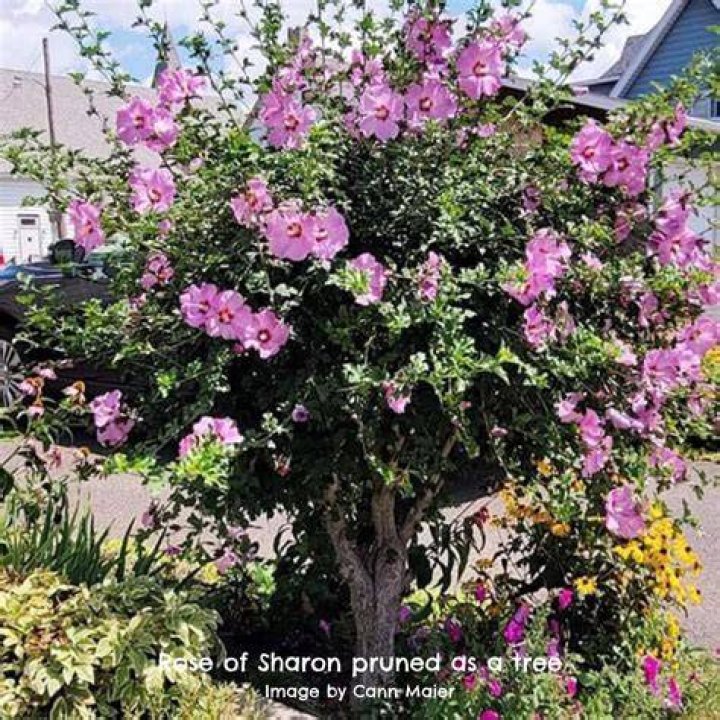
Rose of Sharon "trees" (Hibiscus syriacus) are actually classified by botanists as shrubs, but they can be trained by pruning so as to form one main trunk (thereby becoming tree-like).How fast does Rose of Sharon grow?
Rose of Sharon has a medium growth rate, meaning that it grows approximately 13 to 24 inches a year. A mature Rose of Sharon bush can grow between 8 to 12 feet tall with a 4 to 10 foot spread. The shrubs have a compact, upright growth pattern when young, but tend to spread out as they age.Can you root a Rose of Sharon in water?
Undemanding even when it comes to reproduction, Rose-of-Sharon lends itself well to propagation by stem cuttings. Like most hibiscus, the plant roots easily in water. Take softwood cuttings from Rose-of-Sharon during May, June or July for best results.How do you take care of a Rose of Sharon bush?
Shrub Althea is best planted into rich well-draining, slightly acidic soil in a full sun to part shade location. The rose of Sharon bush prefers moist, well-draining soil, although it will tolerate most soil conditions except those that are soggy or extremely dry.Do you have to deadhead hibiscus flowers?
Deadheading individual flowers as they begin to fade requires no tools. Simply grasp the flower stem behind its swollen base and pinch off the old bloom. You can also snip off the flowers with shears, if you prefer. Hibiscus tends to flower in flushes, so you usually have many old blooms to deal with at once.What to plant near Rose of Sharon?
Nearly any will work, but the following perennials are especially complementary when used for rose of Sharon companion planting:- Purple coneflower (Echinacea)
- Phlox (Phlox)
- Oriental lilies (Lilium asiatic)
- Blue globe thistle (Echinops bannaticus 'Blue Glow')
- Lavender (Lavendula)